Exploring our Natural World with Technology

Category: Weekly Reflections

Final Blog Reflection- Reflecting on the EDCI 336 Course

Looking back over these weeks, the EDCI 336 course kept building on my understanding of EdTech in ways I didn’t expect. Week 2 introduced privacy, consent, and copyright, which made me realize how important it is to protect students’ information and respect creators’ work, even when things online feel “free.”

Week 3 expanded my thinking through Open Education and digital citizenship, and it also included our visit to the PSII School of Inquiry, where talking with Jeff Hopkins helped me see what student-driven, flexible learning can actually look like in practice. This trip was especially eye opening and inspiring, and I found the PSII framework, where multiple subjects are woven throughout assignments especially exciting.

Week 4 focused on online, hybrid, and multi-access learning, and it helped me see that flexible course design isn’t just about convenience but about creating options that support different learners’ needs. We discussed merging modalities and modality definitions, and also looked at different digital learning and literacy frameworks, created to provide K-12 and post secondary institutions with guidelines for developing digital literacy policies and tools.

By Week 8, everything turned more hands-on as Rich McCue led a media-making session that showed how creative digital tools can be in the classroom, and Cari Wilson talked to us about AI in a way that finally made the different types click for me. We were shown by Rich how to use Gemini AI, and discussed reasource for video editing and podcasting, (such as Imovie, Climpchamp and Audacity). Cari explained reactive, predictive, and generative AI using simple examples like robot vacuums, Netflix recommendations, and tools such as ChatGPT, which made me realize how quickly these technologies are becoming part of everyday teaching.

In the end, these weeks helped me understand that EdTech is something much larger than just aquiring software or devices. It is a mindset that forces teachers to think ethically, creatively and stay flexible, as technology is something that is constantly evolving. I enjoyed how our discussions always came back to focusing on the students; their privacy, learning needs, and their access to resources. Overall, EDCI 336 helped me realize that using technology well isnt just about being “tech savvy” but its about being intentional, thoughtful, and creative in the way we integrate it into our classrooms.

Diving into EDtech in the Outdoors

Throughout the semester, I have realized that for students to fully enjoy and connect with outdoor education, it doesn’t necessarily mean stepping completely away from technology. technology when incorporated properly can deepen the way students connect with nature and their environment. Instead of tech being a burden and a distraction, it can actually help students bridge curiosity and understanding.

I believe the most important part of this is using tools that support learners, without overshadowing the natural environment. In one of the articles we looked at, The Guidelines for Technology-Enhanced Learning emphasizes a “human centered” approach where technology is supposed to enhance learning, while keeping accessibility, safety, and student needs the top priority.

The “human centered” approach meshes perfectly with outdoor ed, as when kids are outside and invested in the world around them their learning and curiosity is at its peak. If technology is then introduced without parameters, it can pull the students away from the experience. The tech should be meeting them where they are when doing things like hiking, journalling, observing tides, or identifying species. For example, simple tools like ipads, digital field journals, or photography apps give students the chance to document what they see in real time. One of the sources I found interesting was the Field Journals lesson set from 826 digital, which guides students through becoming “naturalists for the day” by observing nature, sketching, taking measurements, and recording sensory details. I especially enjoyed that the journal structure blends perfectly with digital tools, so students can start with pencil and paper field notes and technology can extend the learning experience, through digital tablets or laptops when students return to class.

The further we progressed into EDCI 336, the more I have realized that outdoor EDtech comes with many responsibilities. The B.C. Post Secondary Ethical Education Technology Toolkit resource our class discussed in unit 4, stresses the importance digital literacy, ethical use, and respecting sovereignty, especially when working on Indigenous land or engaging with Indigenous knowledge.

This responsibility also further extends to the use of AI in outdoor learning and classrooms. AI tools are incredibly convienient in outdoor education- students can identify plants or animals in seconds, field journalling, or for visualizing measurements/data. However, I think we have a responsibility to discuss the negative impacts, “education technologies extend beyond physical waste to include electronic waste, as well as teh carbon footprint associated with manufacturing, cloud storage, and AI applications” (Government of British Columbia, 2025). When you are teaching outdoors, in spaces where the land literally shows the consequences of environmental harm, it is especially important to model responsible tech use.

Overall, the most important part of Outdoor education will always be being present in nature, but with the right digital tools and mentors, students are able to ask better questions, explore more deeply into their own interests, and walk away for a stronger appreciation for the land lasting long after the field trip.

Image Editing and Gemini AI

After our class with Rich McCue discussing googles gemini AI, photo editing, and AI use in the classroom, several things stood out to me. What i liked most was how easy it was to create such a hyper realistic image from just a simple prompt, whereas when using other sources like Chat Gpt for example, the photos produced look animated, and its easy to tell that its AI. However, Gemini shocked me, as I followed Rich McCue’s suggestion, a simple prompt saying, “take this photo of my dogs, and turn them into action figures.”

This was the result, a hyperrealistic picture showing someone holding up a “Heroic Hounds” action figure set, in what looks to be a Walmart or grocery store. The possibilities with this kind of technology are endless, especially in the classroom, as teachers can create visual aids painlessly, prompts for creative writing, or custom posters specific to their unit.

At the same time, AI tech like this scares me, as not only do all students have equal access to this technology, but I think it might create an over reliance on technology, reducing opportunities for students to practice their drawing, photography or other creative skills done by hand. I think AI is still a tool for good, but Gemini AI reminded me that technology is beneficial only when its used with purpose.

Visiting the “Pacific School of Innovation and Inquiry”

Going to visit the pacific school of innovation and inquiry was inspiring, and brought up many new questions relating to inquiry and elementary education. It was also an interesting reflecting experience, as we visited the school after our watch of the documentary, “Most Likely to Succeed.” The visit made me think about inquiry based learning, and how the alternative learning approach might really appeal to some students styles of learning, while at the same time, I realized that the open ended, highly independant approach might clash with some students learning styles who prefer to have more guidance.

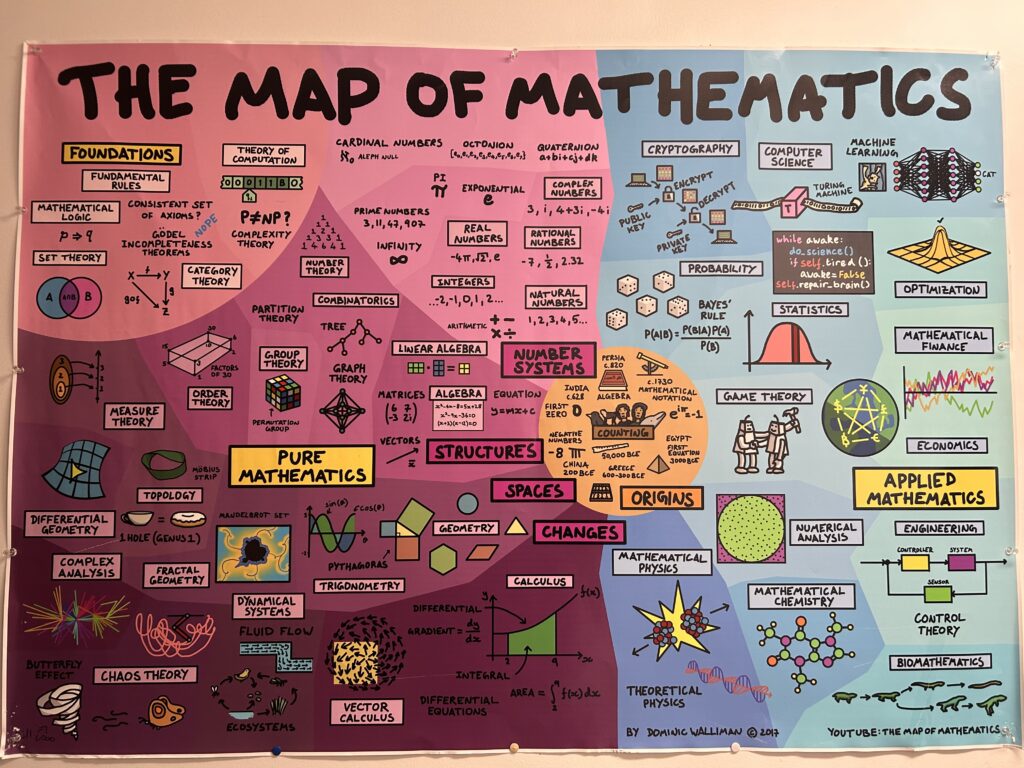
“The Map of Mathematics,” Photo by Gabe Copeland
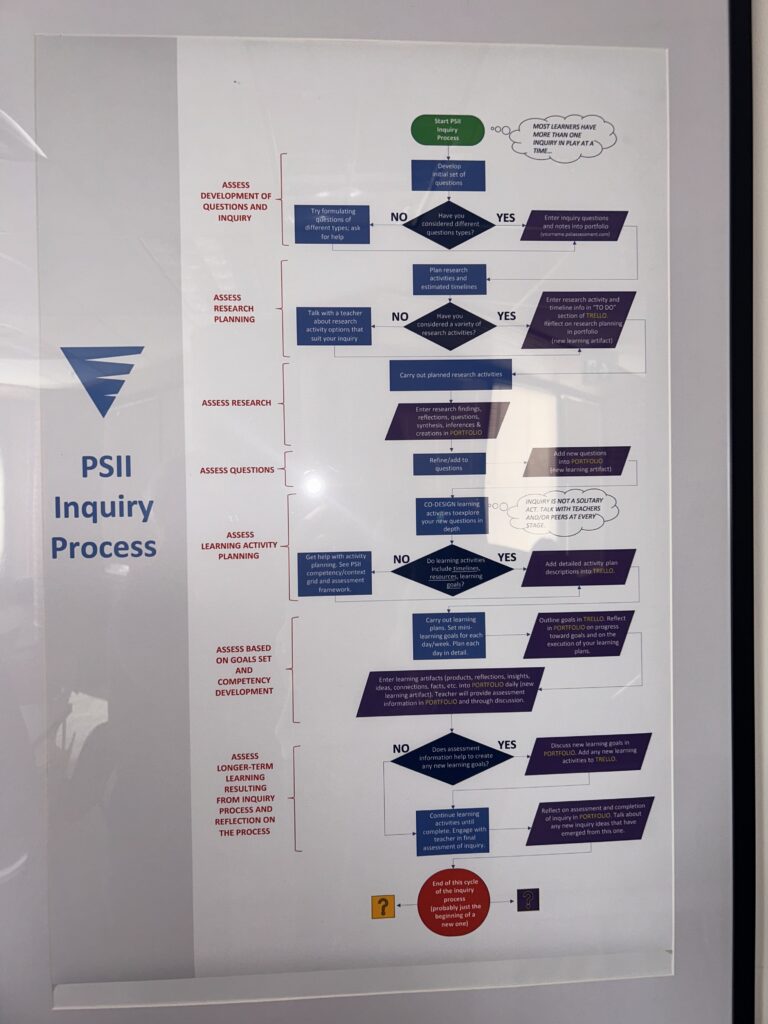
PSII Inquiry Process, Photo by Gabe Copeland, 2025

The PSII Inquiry Process diagram is framed all around the school, demonstrating how students are still guided through their learning journeys. I found this interesting as it shows that the students are still fully supported through school, despite having plenty of flexibility as well.

Additionally, “The Map of Mathematics” is another example of the in-class reasources the PSII school of inquiry has around their campus. This image helps show how the school teaches subjects not as seperate- but as interconnected systems, which increases student learning and encourages curiosity. At the same time, this structure places more pressure on the students to take initiative, explore topics independantly, and pursue their own lines of inquiry outside class.

Overall, my visit to the Pacific School of Innovation and inquiry gave me a better understanding of what inquiry based learning looks like in practice. Seeing how the students balance the strucutre and freedom showed me that while some students who need more instruction may not be able to handle all the freedom that comes with inquiry based learning, it empowers other learners to develop a genuine curiosity in what they are learning.

“Most Likely to Succeed” Documentary Reflection

I really enjoyed watching “Most Likely to Succeed” directed by Greg Whiteley and found High Tech High’s alternative approach to teaching very inspiring. I found it interesting that our current education model is not that different than the original structure designed to create workers, created by the Committee of Ten. Further, with technology constantly growing and advancing yet our education system remaining almost unchanged, more jobs are being taken by computers. Additionally I also really liked the idea of replacing standardized tests with a public exhibition, indirectly encouraging students to try their best on an inquiry project knowing that they will know the people attending. This also cements the learning, rather than doing a written test that the students will forget 3 weeks later.

I found this documentary to be really inspiring. Seeing the school encourage students to use their creativity, critical thinking, problem solving, and teamwork in an inquiry project, thus showing their learning in an open ended and authentic way. Overall the documentary really raised questions for me whether the traditional model truly prepares students for the world today.